Home > News > Industry news
MXene and graphene are the two most widely used two-dimensional nanomaterials in energy storage and electronic devices. Many R&D teams are confused in material selection and cannot accurately match materials according to application scenarios. This article conducts a comprehensive comparative analysis of MXene and graphene in terms of basic performance, device adaptability and industrial advantages.
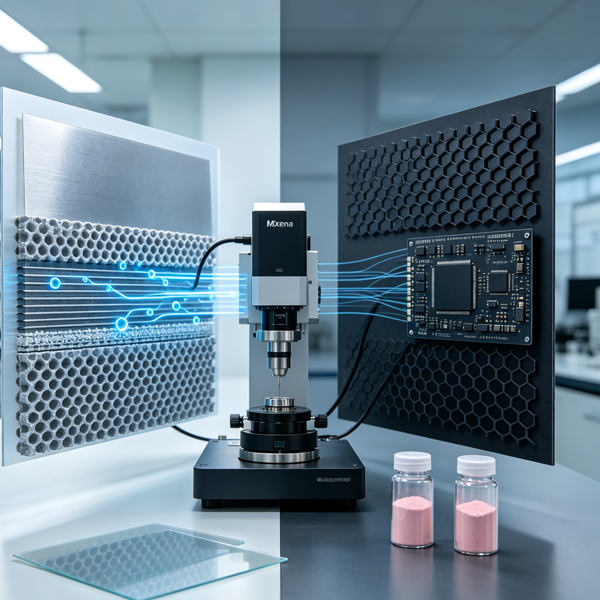
1. Conductivity & Electronic Application Performance
Graphene has ultra-high theoretical conductivity, but industrial graphene products are prone to defect and layer stacking, resulting in decreased actual conductivity. MXene has inherent metallic conductivity, stable conductive network and lower contact resistance. In electromagnetic shielding, conductive coating and flexible circuit applications, MXene has more stable industrial performance and better film-forming uniformity than graphene.
2. Energy Storage Capacity & Rate Performance
MXene has abundant surface functional groups and ultra-high volumetric specific capacity, showing more excellent performance in supercapacitor high-rate charging and low-temperature energy storage. Graphene relies on double-layer capacitance with limited capacity. In fast-charging energy storage devices, MXene has obvious advantages in capacity retention and power density.
3. Processability & Industrial Adaptability
MXene has excellent water dispersion and solution processability, which is convenient for industrial coating, spraying and composite forming. Graphene is easy to agglomerate and difficult to disperse stably, requiring complex auxiliary processes. For large-scale industrial production, MXene has lower processing difficulty and higher product yield.
4. Scenario Selection Suggestions
Choose MXene: Supercapacitors, electromagnetic shielding films, flexible conductive devices, high-rate energy storage equipment, sensor electrode materials.
Choose Graphene: High-precision thermal conductivity films, ultra-high-strength composite structural materials, low-power electronic devices.
MXene shows stronger comprehensive industrial adaptability in energy storage and electronic device manufacturing, while graphene has unique advantages in thermal conduction and structural reinforcement. Nanjing Mission New Materials provides professional material selection technical support and customized MXene material solutions for energy and electronic R&D teams.



Leave your message