Home > News > Industry news
Traditional hydrogen storage methods including high-pressure compression and low-temperature liquefaction consume massive energy and face safety risks, restricting civilian and industrial hydrogen energy promotion. Porous MOF materials have become mainstream research and industrial materials for room-temperature hydrogen storage due to their adjustable pore structure and high specific surface area. This article explains the core working principles and practical optimization methods of MOF-based normal-temperature hydrogen storage. For composite material performance advantages in energy storage scenarios, refer to Complementary Advantages of MOF, MXene and LDH in New Energy Storage Field.
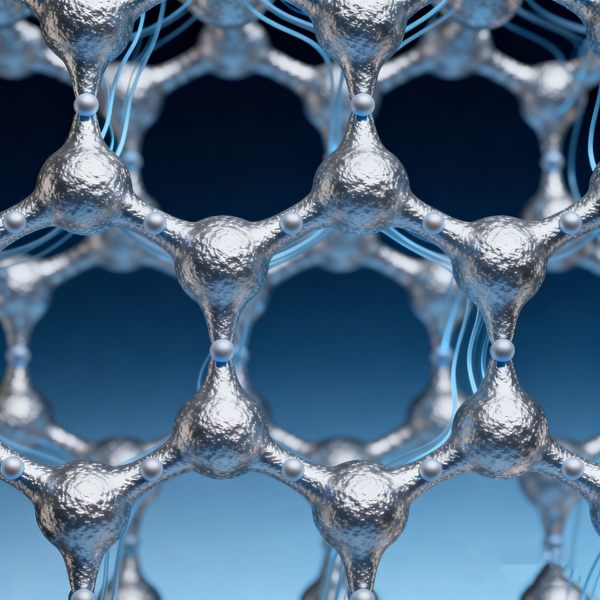
1. Core Structural Basis of MOF for Room-Temperature Hydrogen Storage
The ultra-high BET specific surface area of crystalline MOF powder provides sufficient adsorption sites for hydrogen molecules. Different from traditional porous materials, customizable micropore channels (0.3–2 nm) of MOF can precisely match the kinetic diameter of hydrogen molecules, realizing targeted physical adsorption at normal temperature and pressure. Regular crystal lattice structures effectively lock hydrogen molecules without relying on ultra-low temperature or ultra-high pressure conditions.
At Nanjing Mission New Materials Co.,Ltd, we optimize pore size distribution of custom MOF for hydrogen storage projects, eliminating invalid large pores that cause hydrogen desorption failure and improving room-temperature storage stability for lab test and pilot equipment.
2. Key Technical Means to Improve Room-Temperature Hydrogen Storage Efficiency
Pure unmodified MOF has limited hydrogen adsorption capacity at room temperature. Two mature modification methods greatly boost storage efficiency for industrial and lab use. First, metal node doping adjusts surface electron distribution to enhance van der Waals force between MOF skeleton and hydrogen molecules. Second, organic ligand functionalization optimizes pore surface affinity, avoiding water molecule interference in humid room-temperature environments.
Composite modification with MXene further solves the low conductivity defect of pure MOF, enabling faster hydrogen adsorption and desorption response for cyclic storage equipment.
3. Practical Limitations and Industrial Optimization Solutions
The main bottleneck of MOF room-temperature hydrogen storage is weak adsorption stability under frequent temperature fluctuation. Ordinary MOF is prone to hydrogen leakage in variable ambient temperature environments. Targeted optimization solves this problem: high-stability UiO-series modified MOF maintains stable hydrogen storage capacity under 10–35℃ room temperature cycle, suitable for portable hydrogen storage device R&D.
MOF’s adjustable porous structure and flexible modification technology make it the most promising material for room-temperature efficient hydrogen storage. Nanjing Mission New Materials Co.,Ltd provides customized hydrogen storage MOF powder with tailored pore structure and functional modification, supporting gram-level lab samples and kilogram-level pilot batch supply. Contact our technical team to obtain targeted material solutions for your hydrogen energy R&D projects.



Leave your message